
Love in Las Vegas | Architectural Thesis
North Dakota State University | May 2020
Las Vegas is an exercise in hyper-reality; Disneyland, but with strip clubs, wedding drive-thru’s, and alcohol galore. “The Strip” is famous for its gaudy design and over-the-top décor; it’s all a glamorous and captivating show, but backstage there is nothing but thin, wooden stilts holding up a contextually irrelevant façade. The city’s insistent demand for instant gratification and immediate pleasure has resulted in the creation of a business, not a community. Sin City may be the pleasure capital of the world, but it knows nothing of love and meaningful encounters.
Among the billboards, propped-up facades, and hyper-real casinos of the Las Vegas Strip, my proposal inter-weaves spaces of desire and begins a fervent quest for love, an enigmatic journey, a surrealist fantasy that draws influence from architectural visionaries such Jean-Jacques Lequeu, Douglas Darden, and Claude-Nicolas Ledoux. Through a change in perspective, by lifting the intricate, dazzling dress of the city and peeking at Las Vegas from behind, I hope to evoke unbridled desire and passion.
Herein begins Las Vegas’s love story.
Continue reading the story below, or use these links for a deeper dive into my thesis project.
***Note: This page is best viewed on a desktop/laptop and doesn’t display correctly when viewed on a phone.
The Object of Desire
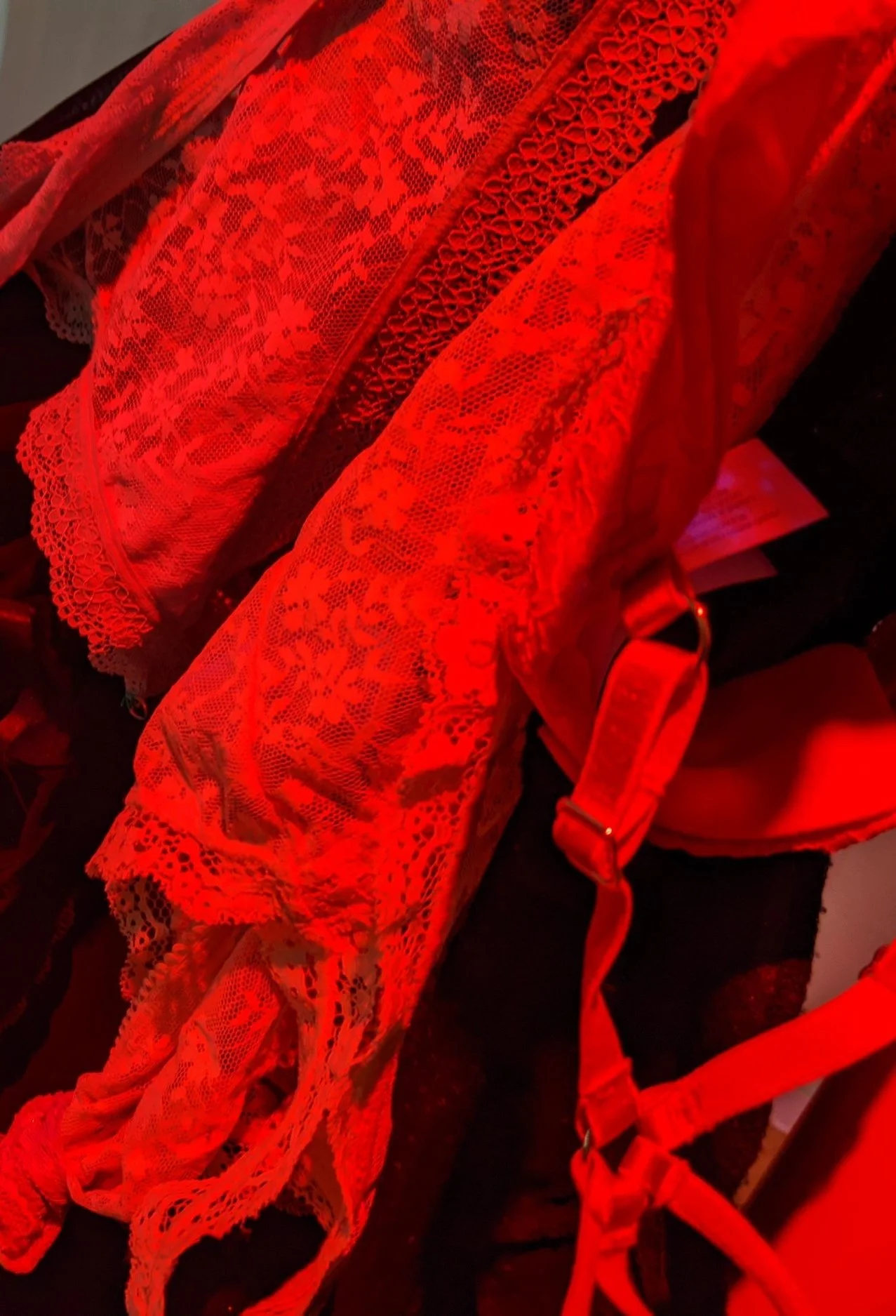
You find yourself sitting in an open room, barren except for the monument of love that stands erected on the computer screen before you, a dazzling and intricate dress displayed atop an easel. The monument stands as a physical representation of the Las Vegas strip, glamorous, alluring…
…but empty.
The city stands amidst the barren Mojave Desert, much like a prostitute might stand along a decrepit street in a neighborhood of ill-repute. She wears her promiscuity and sexuality on her sleeve… brazen, captivating, an effective business transaction.
A soft red light can be seen from inside the dress’s interior. The chest glows, a cord hangs, slipping between the city’s breasts. A synthetic heat beats, a simulation, alive yet eternally dependent... dependent on technology, dependent on consumerism, dependent on the public’s fascination.
The dress, eisel, and heart stand together as the foundation of my artefact, which is a performance art piece that we will be referencing throughout this presentation as it served as the inspiration of my architectural design proposal. What you see before you is a representation of the hyper-real illusion that is Las Vegas, a city that relies on lavish and excessive spectacle in order to retain its iconic image.
Las Vegas, Nevada is a city quite unlike any other: a city of living in the moment, a city of billboards propped up in a desert, an international icon, a playground for adults. Las Vegas is a city founded on the idea of illusion, the spectacle, the show - achieved through its tacky use of allusion to other famous locations around the world, thereby deluding the city’s inhabitants and visitors into thinking of this culturally-barren landscape as an addictive, “anything-goes” utopia.
“The Strip” is famous for its gaudy design, for its flashing lights, for its over-the-top décor; it’s all a glamorous and captivating show, but backstage there is nothing but thin, wooden stilts holding up a meaningless and contextually irrelevant façade.
The Las Vegas Strip is lined with every extravagant form of entertainment one can imagine: from sidewalk bars to circus-style acts, from rollercoasters to ferris-wheels, from the streets of Venice to the pyramids of Egypt. Walking the Las Vegas strip is a surreal experience as you seemingly traverse the world, seeing “everything” while simultaneously experiencing nothing at all.
Las Vegas is an exercise in hyper-reality; Disneyland, but with strip clubs, wedding drive-thru’s, and alcohol galore. Sin City stuffs pleasure and lust in a bottle and slaps a price tag on the bottom, assuring its consumers that what they are selling is the ultimate fantasy, the climax of human experience. People flock to what is otherwise a barren desert landscape for this promise of erotic fulfillment, and yet there is no desire to be found.
How might the inhabitants and visitors of Las Vegas be awoken from this perpetual dream, unfettered from the limitations inherent to hyper-reality? How might architecture be introduced to inspire hope for the future in a city that prides itself on its ability to live only in the moment?
The city’s insistent demand for instant gratification and immediate pleasure has resulted in the creation of a business, not a community. Sin City may be the pleasure capital of the world, but it knows nothing of love, nothing of meaningful spaces and architectural integrity,
Las Vegas is a city without a love story.
Through a change in perspective, by lifting the intricate, dazzling dress of the city and peeking at Las Vegas from behind, I hope to evoke unbridled desire and
passion. I am proposing a series of erotic spaces of flesh and dimension be erected along the Las Vegas Strip, consisting of 4 primary characters, 4 moments of clarity, 4 spaces of desire: the Groom, the Bride, the Voyeur, and lastly the Audience.
The critique can be summarized by this: the immediacy of the Vegas Strip VS the lack (the space in-between) that is essential for desire to be present.
In order to understand the implementation of these spaces of desire in Sin City, it is critical to first contextualize love and eroticism and its embodiment in architecture in centuries past.
The ancient Greeks intimately describe the origin of human love as we know it today, the “birth” of Eros, god of love, sex, and desire (more commonly known today as Cupid).
“Eros was one of three primordial divinities, responsible for the initial separation of the other two, Ouranos (the sky) from Gaia (the earth), who nevertheless permanently copulated, united in the perpetual darkness that preceded the age of man. Primordial Eros was itself complete, androgynous. Only when Time (or Kronos) erupted into the scene and castrated [his father] Ouranos, was human reality set in motion… At this point Eros was reborn, together with Aphrodite, from the blood and semen of Ouranos as it fell into the Mediterranean. In his new incarnation, Eros defines the space/time of human culture as inherently bounded, pierced by an arrow of infinite desire yet always limited, suggesting that in the recognition and embracing of this tension, humanity may also recognize its purpose.”
-Architecture as the Space of Desire: The Hypnerotomachia Polifili.
In this way, it was only through separation, opening a space in-between (in this case the earth and the sky) that human love and desire as we know them today were born, that Eros was given his wings.
The Las Vegas strip continues to be one of the world’s forefront examples of an adult playground, where immediate pleasures of the flesh are abounding. In such a locale, where immediate gratification is demanded, there is no lack, no want, and no desire.
In the work Hypnerotomachia, first published in 1499, the protagonist Poliphilo is on an epic quest for love; he is searching for his beloved Polia, the love of his life, his ‘center’. Falling asleep within a dream, Poliphilo finds himself alone in a dark, foreboding forest… as he traverses the forest’s mysterious interior, he discusses in great detail the architectural marvels he comes across.
He sees and analyzes a monument dedicated to propitious destiny, traverses a circular temple of love that is the epitome of architectural perfection, and is surprised by the erotic altar of Priapus. He explores the interior of a magnificent elephant that contains the tombs of a solar king and a lunar queen, and is forced to make a fateful decision between three life paths: a life of contemplation, a life of political action, or a life of love. He chooses the latter and is joyously reunited with his beloved; however... Polyphilo’s journey is one that incessantly teases and arouses, it is a story of foreplay, a story without a climax. Polyphilo wakes up from his dream in the text’s most heated moment, denying him the sexual fulfillment and intimacy he so desperately desired.
This denial and separation become a recurring theme in love stories both new and old. It is only through allowing a space in between, a space for desire to be fueled and for cupid’s arrow to strike its target, that human love and desire can be grown and cultivated. Polyphilo’s journey is ANYTHING but the reductive and immediate environment of Las Vegas.
“Hypnerotomachia [thereby legitimizes] the possibility and desirability of actually changing the world of human affairs through constructions of the human imagination.”
-Architecture as the Space of Desire: The Hypnerotomachia Polifili.
Taking inspiration from Polyphilo and his quest for love, it is time for our own journey to begin, a surrealist voyage across the Las Vegas Strip comprising 4 sites, 4 spaces of desire, 4 characters.
The Groom
First, the Groom. The primary source of inspiration for the design of the Groom comes from Claude-Nicolas Ledoux’s “Oikema”, a proposal for a “workshop of corruption”, a civic brothel.
This brothel is proclaimed by Ledoux as a “temple of love” where the “boiling and unfaithful youth of [the city would be] free to indulge their sexual appetites to excess and dissolution.”
Ledoux aspired to seduce the city’s youth and take them on a journey, exposing them to the moral ambiguity inherent to sexual desire.
The Oikema’s infamous phallic plan pulls its inhabitants down into the earth, the physical descent paralleling the user’s descent into depravity and domination of the senses.
“As an architectural fiction, [the Oikema] attests to the foundational role of human desire in the city and the expressive capacity of ‘voluptuous’ architecture to engage this desire as its effective public function.”
The groom is the first to enter the scene, desiring to see beneath the dazzling dress of the city. In order to do so, he must first prostrate himself on the ground, getting down on his hands and knees as if in worship of the monument that stands before him. Rolling over onto his back, the groom is put into a vulnerable, very self-aware position. He shimmies his head and shoulders underneath the elaborate facades, a little awkward and cautious in this moment of initial penetration. In this way, he is able to sneak a peek from below, the body of the groom thus forming the underbelly of the artefact. Behind the adorned dress lies an empty void, dark, dimly lit, certainly not the extravagant party that the groom expected and that the exterior implied.
The groom lays beneath the Las Vegas Strip itself, between the Bellagio fountains and the Paris hotel and casino.
The Eiffel Tower stands tall and proud in the background, dominating yet admirable, a reminder of the original city of love. In the foreground lies a single path on-axis with the eiffel tower, unobtrusive yet unabiding as it splits the waters of the Bellagio fountains, splaying the seductive legs of the city herself. You, as the tourist, become acutely aware of the hidden, unbridled passion of the city as you begin your descent down this path, the waters seemingly rising as you traverse deeper into the artificial lake’s interior. Suddenly, as you near the end of the path, a symphony of angelic voices and carefully orchestrated waterworks erupt, an orgasmic celebration that knows no boundaries. Your skin becomes slick with a thin sheet of perspiration, the aftermath of this terrific water display collecting on your exposed flesh. Once you deem yourself satisfyingly moist, you descend into a dark, rugged, and mysterious tunnel that lies at the end of your path.
Then… from the tight confines of the earth, you emerge onto a catwalk overlooking a vaulted, two-story atrium. The scene in front of you is boisterous, active, heated… a passionate dance club. Strippers tempt and tease incessantly atop a backlit glass floor, slick with the spilled drinks of the space’s clientele… thereby reflecting the groin vault above, the groom’s groin. The central light well stands erect as a representation of the groom’s relentless desire, the dark silhouette of a bell suspended in the shaft’s interior, inaccessible and silent in an otherwise loud space.
You are quickly faced with a choice between 3 thresholds, 2 to places unknown and the third back to whence you came. You choose the tunnel to your right, descend a nondescript stair and emerge beneath the dance club you saw before, the backlit floor now a ceiling that highlights the vaulted, almost floral forms that speak of an unprecedented innocence and purity… an innocence that the groom both wishes to preserve and conquer.
Spotlights draw your eyes to the sides of the room where professional performers and dancers enact their craft to the fascination of their spectators. These theatrical performances evoke feelings of longing and natural desire to witness and experience a more poetic form of dance than what we have come to expect from the Vegas strip, especially when juxtaposed against the strip club above.
The structure taking inspiration from the drawings of the visionary architect Jean-Jacques Lequeux, you step into one of the vaulted breasts of the groom, and it is revealed that these spotlights are created by nipple-esque, circular openings in the ceiling overhead. These openings double as glass walkways on the sidewalks on either side of the Las Vegas Strip. As people step across the glass, their shadows are cast across the vaulted forms of the groom’s interior, and thus the groom’s desire to see beneath the dress of the artefact has been manifested.
The Bride
In order to understand desire and love from the perspective of the object of desire herself, we must look at Duchamp’s “Large Glass”, a work of art that remains to this day intentionally unfinished. The work is composed of two large panes of glass, the top containing the bride to be, the object of desire, and the bottom representing the bachelors in waiting. Eternally divided, the bachelors will never be united with the bride, and yet the constant visual temptation ensures their desire remains perpetually present.
The bride is on display, the center of attention, and yet the desire present does not belong solely to the bachelors in waiting. No, it is not enough for the bride to be seen, and to be admired walking down the aisle; she too desires to see herself. The Virgin bride strips herself in the look of those who look at her. In this way, the bride depends on the bachelors; they are the instrument of her desire to see herself.
The desire of the groom is only intensified as the bride enters the scene, stool and pole in hand. Wedging the heavy wooden stool against her beloved’s loins, the bride forces the groom to spread his legs. The bride takes her seat, tantalizingly close to her beloved as she sits atop the groom’s groin. Her body faces the audience as she crouches, perched atop the groom’s lap, suspended between promise and sexual gratification. The bride is on display, the main event… and yet the groom and bride cannot see each other in their entirety.
It becomes apparent in this moment that this performance is not only the embodiment of the groom’s desire for the bride, but (much like in Duchamp’s ‘Large Glass’) is also the projection of the bride’s desire to see herself, to be looked at, and to be admired.
The bride hangs suspended above the Fashion Show Mall on the northern end of the Las Vegas Strip. She is held in tension by five delicate cables from an ovular cloud, five fingers composing a hand that grasps at rings that lie at its fingertips.
This bizarre apparatus is wrapped around a glass tube and walkway much like the bride’s fingers wrap around and clutch the pole in front of her. This protrusion emerges from the subterranean Fashion Show Mall and is put proudly on display, the bride’s focal point, the wedding aisle.
As you enter and traverse this glass tube, you are made acutely aware of your transparent and exposed position, a moment of absolute visual violation. You have taken the place of the bride as you walk down the aisle towards a bell that lies in the distance, the arched forms on either side of you sequentially tightening as your excitement escalates, the bell seemingly growing... almost within reach… but at the last moment the path diverges, your climax halted, the bell once again visually tempted but unreachable.
Below this walkway is suspended a peculiar and erotic rigid frame structure, a series of x’s denoting three separate but connected all-you-can-eat buffets. The wedding banquet has commenced, the table set, the bride’s gluttonous desire to be seen, to see herself, and to be devoured translated into spaces of consumption.
However, the apparatus of love that is the artefact is not complete without the participation of a third party, an outside observer, the voyeur.
The Voyeur
To understand the perverted, visually-violating nature of the Voyeur, it is critical to discuss the Boudoir of Mademoiselle Dervieux.
Mademoiselle Dervieux was a public woman, a prostitute, and an actress. She amassed a fortune over the years through a combination of Opera performances as well as private performances at royal residences. She “decided to build a showcase for herself, advertising the sexual promiscuity that was a privilege of the French Elite” at the time. She made her own ‘temple of love’ that served as a casino and adult playground for aristocrats.
In the boudoir, or private bedroom, “an empty chair, in the reflection of a mirror, marks the site of a privileged view that [is] shared by the guests who [wait] their turn with [the lady of the house]”.
In this way, the architecture forces the observer to simultaneously look at their object of desire as well as a reflection of themselves, thereby compelling the voyeur to recognize the distance in between and take accountability for their perverted gaze.
This theme continues with the altar of this temple of love, the site of sexual arousal and fulfillment, the bed itself.
“As the stage for the voyeur’s sexual fantasies, the boudoir provides an erotic tableau where [the guest] is simultaneously actor and spectator, both near and far from his object of desire, suspended between promise and sexual gratification.”
In order to get into his respective position, the voyeur must first approach the monument of love from behind, reaching underneath and pulling, revealing his lustful intentions, his desire for visual violation. Undergarments and delicate lingerie soon hang suspended in tension, obscuring the bride’s face as well as her vision. The voyeur must straddle the groom’s legs, the voyeur’s crotch at about eye level with the seated bride. The voyeur stands apart, and yet is indisputably a part of the act itself as he leers through the apparatus, much like a peaking tom might slyly steal a glance through a window in the hope of seeing a couple in the midst of an erotic embrace.
The voyeur is located on a pedestrian street called the Linq, which branches off of the Strip. A massive ferris wheel dominates the scene, each spherical carriage gleaming like an eye of a hunting predator.
The voyeur, in the form of a watchtower, stands proudly in the foreground, legs spread, head held high as he peeks over the surrounding context. The courtyard beneath is an influencer’s dream, the arched forms and playful geometry creating a plethora of “instagrammable” moments. As you walk underneath the spread legs of the voyeur, you are treated with a captivating view of his undercarriage, a bell gently hanging, swinging oh so slightly... to and fro.. and to again.
Just beyond the bell lies a mirror, reflecting the courtyard below. And around its perimeter is held a glass-walkway. In this way, a top-down view is juxtaposed against a bottom-up view, a disorienting and revealing perspective that both beguiles and repulses as you see the shining scalp of a balding older gentleman directly adjacent to the revealing mini-skirt of a particularly attractive woman that stands above the glass platform.
The looming eye of Ouranos himself peers down from above as you ascend the elevator to the overlook above. Couples take repulsively cute photos of each other, the Strip a backdrop for their next instagram post. Meanwhile, directly above exists a space that takes a more critical approach to the voyeuristic gaze. This curated photography exhibit features a rotating selection of work from local professionals, providing an alternative, and hopefully more comprehensive, way to see and understand the city that lies below.
The Audience
Finally, the audience joins the show. At this time, I invited the audience to come forward and walk around the artefact, interrupting the desert projection, their shadows being cast on the white, linen bed sheets, thus blurring the distinction between actor and spectator. Everyone was instructed to line-up single file, reminiscent of the long waiting queues to be found in front of Vegas’s most notable attractions, particularly the Welcome to Las Vegas sign. Each audience member had the opportunity to pluck the bride’s flower, represented by the cone sprouting from the tip of the pole in front of the voyeur’s face.
The audience plays the role of the tourist, walking around and exploring the iconic Vegas strip. They are the wedding guest, both watching and participating in the performance of the artefact which serves as a wedding ceremony for the city of Las Vegas. They look through their recently acquired cone-shaped apparatuses that now serve as spy glasses, helping each participant to see the artefact, and by extension Sin City, in a new way.
The audience is located at the very beginning of the Strip on the south end, just down the street from the iconic ‘Welcome to Fabulous Las Vegas, Nevada’ sign. Nearby sits the Little Church of the West, the oldest existing building on the strip, and one of the city’s first wedding chapels. As you approach the wedding chapel that is surrounded by nothing but dirt, asphalt, and a shifty-looking motel, you notice that directly adjacent lies what appears to be a large hole in the ground, a dome clearly visible in the distance. This hole is an inverted church, a void, a tangible representation of the lack of love and commitment on the Strip.
A singular path, the aisle, descends towards the altar of this inverted church, which in turn leads you to a procession of stairs. You delve deeper and deeper into the earth’s womb, the air becoming increasingly moist, the atmosphere thick and weighted.
Upon entering into the altar, you are greeted by an incessant, albeit pleasing, ringing, ringing, ringing... a ringing of bells, a ringing that was noticeably absent at each of the other sites.
A wedding ceremony has started.
The vaulted ceiling and repeating arched geometry once again recall churches of old and love stories long past, but this perspectival view quickly becomes perverted, the altar revealed to be a bedchamber, a boudoir. A heavy, concrete belly bulges above, swollen and bloated, perpetually pregnant above the space of consummation and erotic fulfilment, the bed itself, which lies on a raised pedestal. This bed is encased in a glass enclosure, a visual temptation that lays permanently out of reach. Surrounding this enclosure, lie three arched indentations, on each of which is projected live-time video footage of the three other sites, bringing together that which is far into an incredibly intimate and revealing space that explores and reveals the Groom’s relentless desire to undress and conquer, the Bride’s gluttonous desire to be seen and devoured, and the Voyeur’s reductive, omnipresent, and perverted gaze.
Thus, the audience serves as a temple of love, a culmination of the architecture spread over the length of the Las Vegas Strip, a climax to this erotic journey, and a testament to the untapped passion that Sin City inherently embodies.
In the hollowed sphere, this passion is at its most potent, burning hot, flames flickering around the perimeter of the sphere’s interior. The sphere is suspended between earth and sky, inhabiting both and neither, reminiscent of the original space of desire that permanently separates earth from sky, Gaia from her lover Ouranos. At its center is suspended a singular platform with a circular glass floor on which you are invited to lay down, the bed below framing your body. A light flashes, a photo is taken, a snapshot in time printed and placed in your hand. You take the flimsy piece of photo paper to the sphere’s perimeter and drop it into the inferno, your image quickly devoured and consumed by the flames and turned to ash.
The ash falls... falls... falls... sliding down the concave walls... and drops onto the bed that rests beneath this space of consummation and consumption, permanently staining its previously pure white sheets.
Over time, the bed and pedestal together become coated in a thick sheen of ash, moments in time permanently captured and laid to rest, a memory of your journey embodied and memorialized.
*To see a higher quality version of this graphic (which is my final thesis board), see the link at the top of this page
Conclusion
And thus, Las Vegas remains a spectacular and flamboyant show, but now with desire and tension present. Both the artefact and the city of Las Vegas remain empty shells, beautiful dresses on display, until the participants provide their bodies. It is through interaction and participation that the artefact becomes erotic…
…that the city of Las Vegas is given a body.